Preparing for the GTU Programming for Problem Solving (PPS) exam? Practising previous year question papers can help you understand C programming, improve your logic, and prepare for theory and practical questions.
The GTU PPS previous year paper is a useful resource for first-year engineering students. It helps you review important concepts, practise common programming problems, and learn how to present answers in the exam.
If you are searching for a GTU PPS PYQ, GTU PPS paper 2025, or GTU PPS practical programs, this guide covers the key topics to practise, useful old papers, and a simple study plan.
You will also learn how to find repeated question types without relying on predictions about the next exam.
Where to Find GTU PPS Previous Year Papers
You can find previous year question papers through the official GTU website and educational resources that collect past examination papers.
1. GTU Official Question Paper Repository
The official GTU Question Paper Repository lets students search previous papers by exam session and course. You can also search by subject code within the selected scope.
Follow these steps:
Open the official GTU question paper repository.
Select the relevant exam session.
Choose your course.
Search for Programming for Problem Solving using your subject code.
Open the matching paper and save the PDF for practice.
Important: Check the subject code before downloading a paper. Programming for Problem Solving appears under codes such as 3110003 and BE01000121 in different B.E. course or syllabus listings. Use the code assigned to your own course. https://www.gtu.ac.in/student-corner/examination/question-paper-repository
2. Find GTU PPS Papers on GTU Hero
GTU Hero provides a place to explore study resources for Gujarat Technological University exams.
Visit GTU Hero to check the available question papers, study material, and other exam preparation resources.
Before using any downloaded paper, verify its subject code, exam session, and syllabus. Make sure the paper matches your current course.
3. GTU PPS Paper 2025
Students looking for the GTU PPS paper 2025 should check both Summer 2025 and Winter 2025 examination resources.
These papers can help you understand how GTU frames questions on algorithms, C programming, loops, functions, arrays, and other syllabus topics.
You can explore these publicly available paper pages:
These resources are useful for practice. Cross-check the original paper against GTU's official repository before relying on a downloaded copy.
Why Should You Solve GTU PPS PYQs?
A previous year question, or PYQ, comes from an earlier examination. These questions help you understand how programming concepts are tested.
Solving GTU PPS PYQs can help you:
Learn how to write algorithms and C programs.
Understand the use of conditions, loops, and functions.
Improve your ability to trace program output.
Practise debugging and finding coding errors.
Identify concepts that deserve more revision.
Improve your speed through timed practice.
However, solving PYQs alone is not enough. New questions can test the same concept in a different way.
The best approach is to understand the logic behind each program instead of memorising code word for word.
Most Asked Programs in GTU PPS
The best way to prepare for PPS is to practise core programming problems that build your C language skills.
The following list covers useful question types drawn from common introductory C programming topics and examples found in available GTU PPS papers. It is a practice priority list, not a verified statistical ranking of the most repeated programs.
1. Even or Odd Number
This program checks whether a number is divisible by two.
Concepts: if-else, modulus operator (%), input and output.
#include <stdio.h>

int main(void) {
    int n;

    printf("Enter a number: ");
    scanf("%d", &n);

    if (n % 2 == 0)
        printf("Even number");
    else
        printf("Odd number");

    return 0;
}
Practise writing the algorithm and flowchart for this problem, too. An even-or-odd algorithm appeared in the Winter 2025 PPS paper for subject code 3110003. https://unfoldprep.com/papers/gtu/be-common/sem-1/3110003-programming-for-problem-solving-winter-2025/
2. Factorial of a Number
The factorial of a positive integer is the product of all positive integers up to that number.
For example, (5! = 5 \times 4 \times 3 \times 2 \times 1 = 120).
Concepts: Loops, variables, multiplication, recursion.
Prepare both iterative and recursive methods if they are part of your syllabus.
3. Prime Number Check
A prime number is an integer greater than one that has exactly two positive factors: one and itself.
Practise writing a program that checks whether an entered number is prime.
Concepts: Loops, conditions, divisibility, Boolean flags.
Test your program using values such as 1, 2, 7, 9, and 15. Remember that 1 is not a prime number.
4. Fibonacci Series
The Fibonacci series starts with 0 and 1. Each later term is the sum of the two previous terms.
Example output for six terms:
0 1 1 2 3 5
Concepts: Loops, variables, updating values, recursion.
Practise generating a fixed number of terms and handling small inputs correctly.
5. Sum of Digits of a Number
This program adds the individual digits of an integer.
For example, the sum of the digits of 145 is 10.
The usual approach is to use % 10 to obtain the last digit and / 10 to remove it from a positive integer.
Concepts: while loops, modulus, integer division.
A sum-of-digits problem appeared in an available Winter 2024 PPS paper. https://www.scribd.com/document/862989510/PPS-GTU-Papers
6. Reverse a Number and Check for a Palindrome
A number is a palindrome when it reads the same forward and backward. Examples include 121 and 1331.
Learn how to reverse an integer using a loop. Then compare the reversed value with the original value to check for a palindrome.
Concepts: Loops, modulus, integer division, temporary variables.
7. Largest of Three Numbers
This program compares three input values and prints the largest one.
Practise both nested if-else statements and logical operators.
Concepts: Conditions, comparisons, logical operators.
Be careful with equal values. Your conditions should work when two or all three inputs are the same.
8. Armstrong Number
An Armstrong number equals the sum of its digits, each raised to the power of the number of digits.
For example, (153 = 1^3 + 5^3 + 3^3).
Concepts: Loops, digit extraction, arithmetic operations.
Start with three-digit examples. For a general solution, count the digits and use the correct power for each digit.
9. Pattern Printing
Pattern programs test your understanding of nested loops.
Practise printing:
Right-angle star patterns.
Number triangles.
Increasing and decreasing sequences.
Alphabet patterns.
Pay close attention to the number of rows and columns. A pattern can be incorrect even when the loop structure is nearly right.
10. Arrays: Sorting and Searching
Arrays let you store several values of the same data type.
Practise these programs:
Find the largest and smallest array elements.
Calculate the sum and average of array elements.
Sort an array in ascending order.
Search for a given element.
Find duplicate values, if included in your syllabus.
These problems test loops, indexes, comparisons, and array traversal.
11. Matrix Operations
Practise basic matrix operations if matrices are included in your prescribed PPS syllabus.
Useful exercises include matrix addition, subtraction, and multiplication.
Focus on nested loops and correct row and column indexes.
12. String Programs
Strings are another important area of C programming practice.
Try programs to:
Find the length of a string.
Reverse a string.
Check whether a string is a palindrome.
Count vowels and consonants.
Compare two strings.
Count words or characters.
Learn the difference between using standard string functions and solving a problem without them. Follow the method requested in the question.
13. Functions and Recursion
Functions help divide a program into smaller, reusable parts.
Practise writing functions to find factorials, calculate powers, check prime numbers, and perform other basic operations.
For recursion, identify the base case and the rule that reduces the problem. Without a correct base case, recursive calls may not stop.
14. Programs Using Pointers and Dynamic Memory
If these topics are part of your course, learn pointer basics and dynamic memory allocation.
Practise using pointers to access values and understand functions such as malloc(), calloc(), realloc(), and free().
Write short examples and learn why allocated memory should be released when it is no longer needed.
What Do GTU PPS Old Papers Tell Us?
Reviewing different exam sessions helps you see how the same concepts can appear in different forms.
For example, the available Winter 2025 paper for subject code 3110003 includes an even-or-odd algorithm, operator precedence, loop concepts, character classification, and program-writing questions. https://unfoldprep.com/papers/gtu/be-common/sem-1/3110003-programming-for-problem-solving-winter-2025/
The available Summer 2025 paper includes questions on factorials, conditional statements, prime numbers, arrays, strings, functions, and file handling. https://unfoldprep.com/papers/gtu/be-common/sem-1/3110003-programming-for-problem-solving-summer-2025/
These examples suggest that students should practise both basic logic and longer programs.
They do not establish that a particular question will repeat in the next exam. Always check your current syllabus and prepare beyond a short list of predicted questions.
GTU PPS Practical: Programs and Viva Preparation
The GTU PPS practical focuses on applying programming concepts. Your exact practical tasks depend on your course, syllabus, and instructions from your college.
A useful preparation plan covers program writing, testing, output tracing, and basic theory.
Practical Programs to Prepare
Use this checklist to track your progress.
Even or odd number
Factorial using a loop
Prime number check
Fibonacci series
Sum and reverse of digits
Palindrome number or string
Largest of three numbers
Star and number patterns
Array sorting and searching
Matrix addition
String operations
Functions and recursion
Treat this as a practice checklist, not a confirmed list of mandatory practical questions.
Common PPS Viva Questions
Prepare clear answers to questions such as:
What is an algorithm?
An algorithm is a finite sequence of steps used to solve a problem.
What is a flowchart?
A flowchart uses symbols and arrows to show the steps and decisions in a process.
What is the difference between a compiler and an interpreter?
A compiler translates source code into another form before execution. An interpreter executes instructions through an interpretation process. The exact behaviour depends on the language and implementation.
What is the difference between while and do-while loops?
A while loop checks its condition before executing the body. A do-while loop checks its condition after the body, so it executes at least once.
What is recursion?
Recursion occurs when a function calls itself to solve a smaller part of a problem.
What is the difference between break and continue?
break exits the nearest loop or switch statement. continue skips the remaining statements in the current loop iteration and moves to the next iteration.
Review data types, operators, arrays, strings, functions, and pointers as well. Practise explaining your own code, since understanding each step is more useful than memorising definitions alone.
How to Prepare for GTU PPS in 7 Days
If your exam is approaching, use this sample plan to cover the core topics.
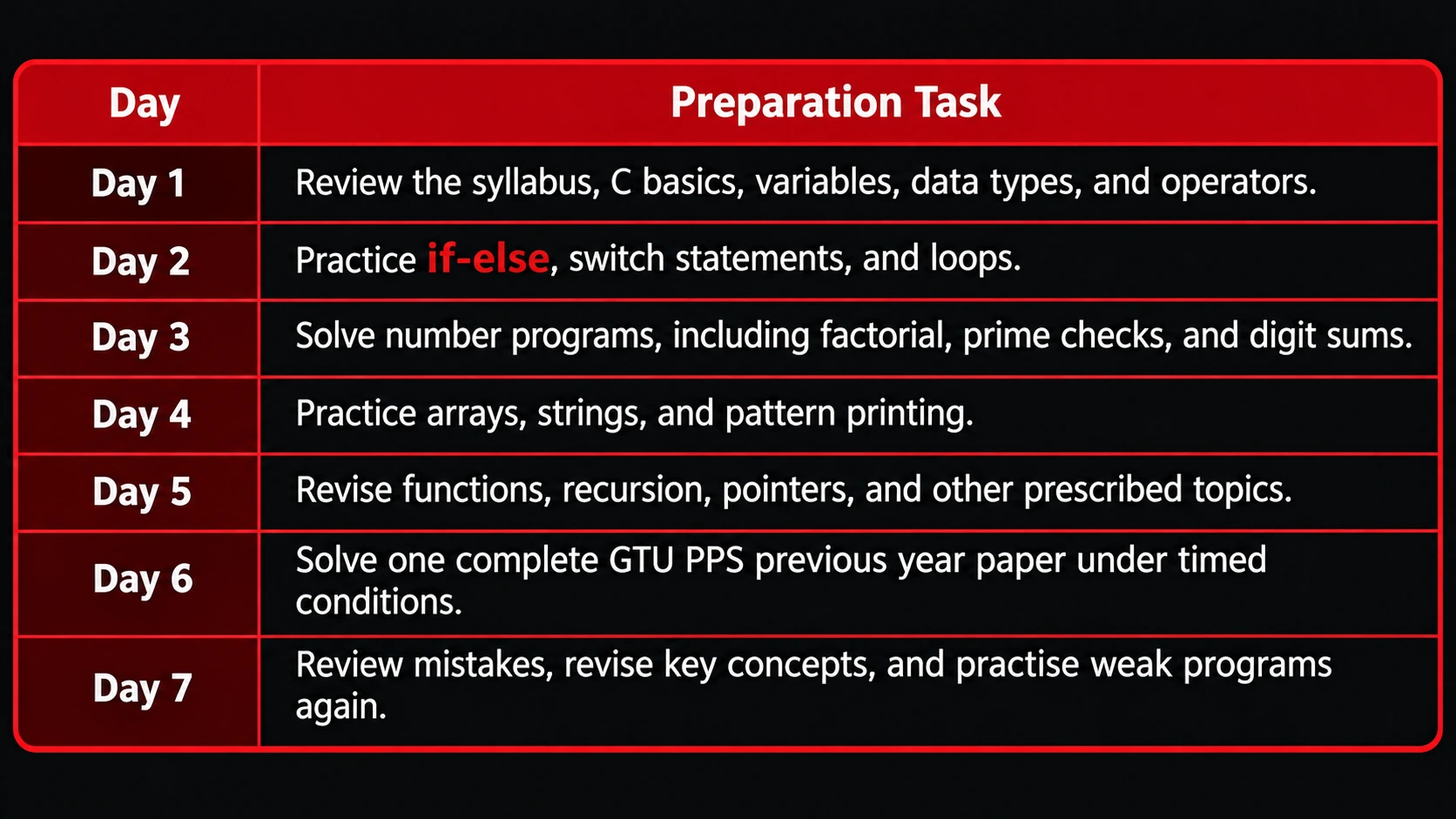
Adjust this schedule to your syllabus and the time remaining before the exam. Do not skip a topic just because it did not appear in the few papers you reviewed.
Common Mistakes to Avoid in the PPS Exam
1. Memorising Code Without Understanding It
A small change in input can expose gaps in your logic. Understand the purpose of each variable, condition, and loop.
2. Ignoring Syntax
Missing semicolons, incorrect braces, and wrong format specifiers can cause errors. Practise writing complete programs without relying on an editor's auto-completion.
3. Forgetting Edge Cases
Test your program with zero, negative values where relevant, repeated values, and small inputs. Make sure it handles the cases allowed by the question.
4. Skipping Output Testing
Trace the program line by line. Check whether each loop stops at the right point and whether each variable holds the expected value.
5. Ignoring Theory Questions
PPS preparation is not only about writing code. Revise algorithms, flowcharts, data types, operators, control statements, and the other theory topics in your syllabus.
6. Depending Only on Repeated Questions
Old papers are useful study tools, not promises about the next examination. Build the skills needed to solve new questions using familiar programming concepts.
Frequently Asked Questions About GTU PPS Papers
1. Where can I download the GTU PPS previous year paper?
Start with the official GTU Question Paper Repository. Search by your exam session, course, and subject code. You can also check GTU Hero for available study resources.
2. Where can I find the GTU PPS PYQ for 2025?
You can review the Summer 2025 and Winter 2025 session papers for the relevant PPS subject code. See the available Summer 2025 paper and Winter 2025 paper. Verify the original paper against GTU's official repository.
3. Which programs are important for GTU PPS?
Start with number programs, factorials, prime checks, Fibonacci series, digit operations, pattern printing, arrays, strings, and functions. Then revise the remaining topics in your current syllabus.
These are useful practice priorities, not guaranteed exam questions.
4. Is the GTU PPS practical different from the theory exam?
Practical work focuses on applying programming skills, writing and testing programs, and explaining your logic. The theory exam may include definitions, algorithms, output tracing, and program-writing questions. Your exact assessment format depends on your course requirements.
5. How many GTU PPS old papers should I solve?
Try solving three to five papers from the same syllabus scheme, if time allows. Review every mistake and solve weak questions again. Understanding the solutions matters more than collecting a large number of PDFs.
6. Can I pass PPS by studying only repeated programs?
Relying only on repeated programs is risky. Learn the key concepts behind each program and practise variations. Review the full syllabus, including theory and other required topics.
7. How should I prepare for PPS practical and viva?
Write programs without looking at the answer, test them with different inputs, and explain how they work. Revise basic C concepts and prepare short answers to common viva questions.
Final Thoughts
The GTU PPS previous year paper is a valuable resource for preparing for your Programming for Problem Solving exam. It helps you understand how GTU tests programming logic and gives you a clear way to measure your progress.
Start with the official GTU question paper repository. Download papers that match your subject code, practise common C programming problems, and use solutions to correct your mistakes.
For the GTU PPS practical, focus on writing, testing, and explaining programs. For the theory exam, revise the core concepts alongside your coding practice.
Most importantly, do not rely on predictions alone. Build a strong grasp of C programming so you can solve both familiar and new questions with confidence.
Visit GTU Hero to explore study resources for your GTU exam preparation.